Tag Archives: Libya

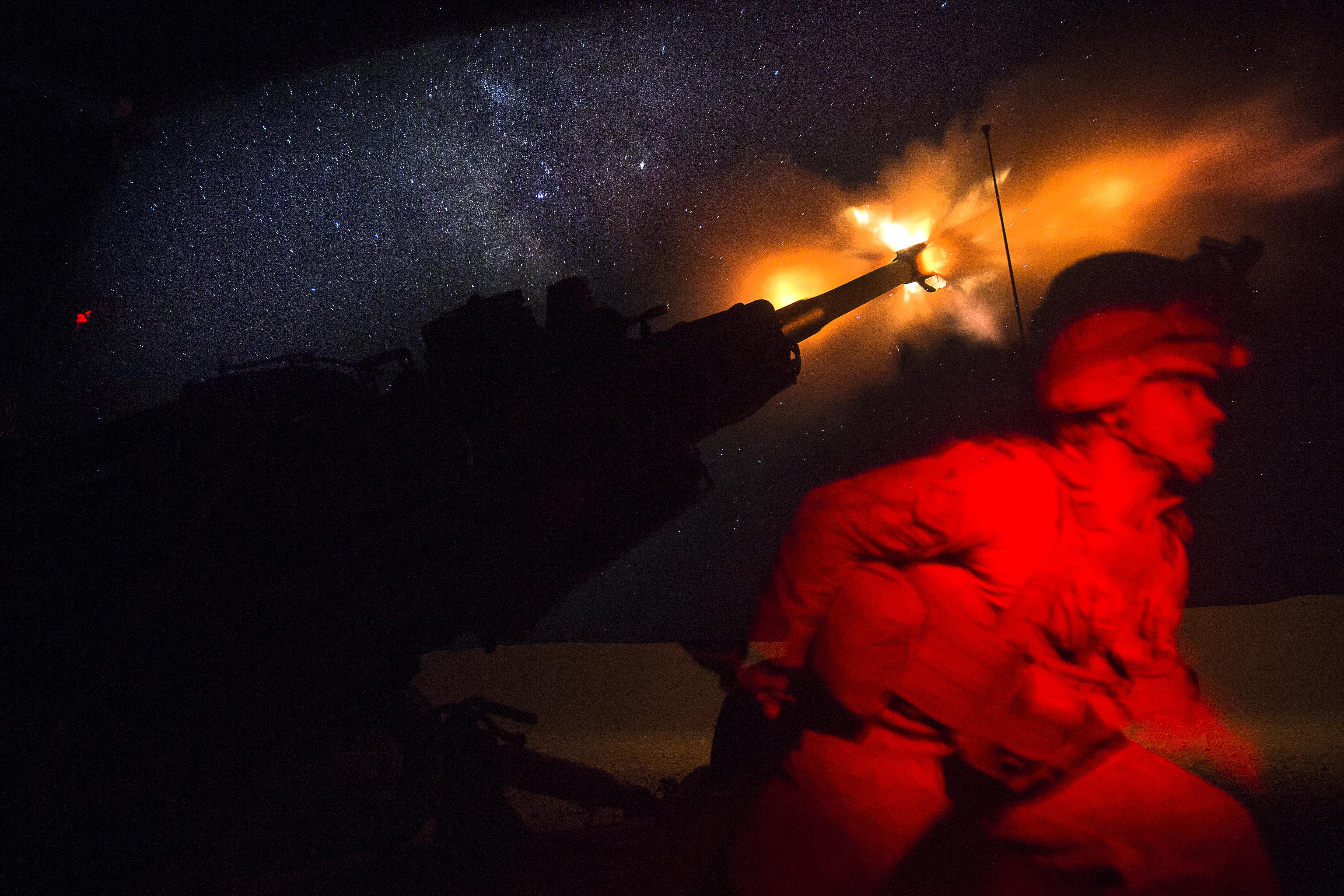
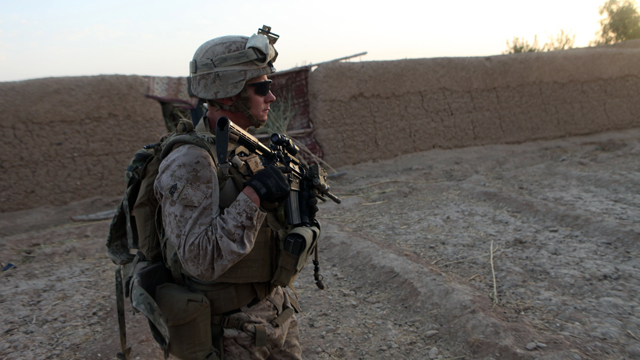
Marine with Special-Purpose Marine Air-Ground Task Force 12.2. US Marine Corps Photo

New USMC Unit Will Provide Faster Punch in Africa and Middle East

By:
Marine with Special-Purpose Marine Air-Ground Task Force 12.2. US Marine Corps Photo

Marine with Special-Purpose Marine Air-Ground Task Force 12.2. US Marine Corps Photo

Marines are building on decades of experience in fielding responsive Marine Expeditionary Units (MEUs)—embarked on board Navy Amphibious Ready Groups, (ARGs)—to deliver an even faster first punch.

The new Marine Air Ground Task Force-Crisis Response (MAGTF-CR), will operate in the Mediterranean to give the United States quicker response times to trouble in Africa and the Middle East. Instead of a ship-deployed force, the unit will be based around a company of infantry Marines, six MV-22 Ospreys, and two KC-130J Hercules fixed-wing aircraft. This is a surprising move for a Marine Corps that wants to return to amphibious roots.  Read More

Odyssey Dawn

NATO’s Maritime Strategy and the Libya Crisis as Seen from the Sea

The following is a paper from the NATO Defense College Rome, published in March, 2013.
From the report:

In case you did not know, the North Atlantic Treaty Organization (NATO) has an Alliance Maritime Strategy (AMS). The document, approved on 05 January 2011, was the first of its kind in over a quarter of a century. In spite of this post-Cold War milestone, however, the strategy was endor- sed by the member states with little fanfare. Since its declassification in March of the same year, it has been quietly buried in the NATO official website, largely out of sight from the popular media and (by extension) from the European and North American populace whose security and prosperity it is ostensibly designed to safeguard.2 The average person on the street (or, perhaps more aptly expressed in this context, on the sea- front) should therefore be forgiven if he or she has never heard of, let alone read, a dedicated maritime strategy for the Atlantic Alliance in the 21st century. But exist it does. Read More

Trends in Hybrid and Irregular Warfare

By:

Proceedings, September 2012
Savvy adversaries are more capable than ever of using high-tech gadgets and social media against the United States.

From Tunisia to Cairo, Sanaa, Bahrain, Benghazi, Damascus, London, Wall Street, Berkeley, and the University of California, Davis, 2011 was the year of the social-media revolution. Smartphones and social media have enabled groups of like-minded individuals to share information, spread their messages, and upend traditional relationships between the public and authorities. These developments are part of a continuing trend in the democratization of information: the empowerment of groups and individuals by information technology. Combined with the democratization of destruction, or the expansion of access to destructive technology and tactics, small groups and individuals will have greater ability to counter traditional security forces in hybrid and irregular conflicts, where force-on-force military engagements may be blended with other operations aimed at influencing key populations.1

ScharreF1Sept12

The future operating environment will be one of contested domains—air, land, sea, space, cyber, the electromagnetic spectrum, and increasingly, the influence domain, where individuals and groups compete to spread their messages. U.S. military forces must be prepared for future challenges within these domains from nation-states as well as non-state groups or individuals. While the Department of Defense (DOD) is generally good at estimating and preparing for challenges from organized military forces, threats from non-state groups tend to be more diffuse and decentralized, more organic, and less predictable in nature.2 The continued diffusion of power to non-state groups will increase the challenges associated with irregular and hybrid warfare, with significant implications for U.S. forces.3

The Democratization of Information

The widespread availability of social media and Internet-capable smartphones has transformed relationships between the public and traditional authority. In the past few years, these technologies have helped non-state groups record and broadcast abuses of power, organize to form ad hoc collectives, and counter messages from authorities. In many cases, authorities have been slow to realize the implications of these changes. Even U.S. domestic agencies have repeatedly been embarrassed by incidents in which officials have been recorded using heavy-handed tactics. Images and video of peaceful protesters being pepper-sprayed, abused, or intimidated by law-enforcement officials in New York, Berkeley, UC Davis, the University of Maryland, and Washington, D.C., have led to outrage, suspension of offending officials, and in at least one case felony criminal charges.4

Read More

Embassy Security: The Strategic Context

By:

On the 11th anniversary of the attacks on the World Trade Center and Pentagon, al Qaeda affiliates staged a series of attacks against U.S. diplomatic missions in the Middle East.  Inciting protests against the film, “Innocence of Muslims,” or possibly taking advantage of existing demonstrations, militants with alledged links to Al Qaeda burned the U.S. consulate in Benghazi, Libya, and killed Ambassador Christopher Stevens, Foreign Service information management officer Sean Smith and two contracted American security personnel. Within days, violent protests sprung up in over two dozen countries across the Muslim world.  In Sana’a, Yemen, protestors forcibly entered the U.S. Embassy compound and burned the American flag, replacing it with a black flag bearing the Islamic shahada.

Since the Benghazi attack, Al Qaeda and Hezbollah have threatened U.S. personnel and facilities.  In light of Ambassador Stevens’ death, and remembering the 52 Americans held hostage for 444 days by “protestors” in Iran, there is growing concern about the ability of Americans to protect themselves inside diplomatic missions. While Marines from Fleet Anti-Terrorist Security Teams (FAST) have been deployed to Yemen, questions remain as to why Marines or other U.S. military forces have not been sent to other embassies. Before we discuss the operational details of what U.S. forces are available, it is imperative that we understand the political context in which our military is used to protect U.S. diplomatic missions abroad.

Fleet Anti-Terrorist Security Team during an international training exercise. U.S. Marine Corps Photo

Fleet Anti-Terrorist Security Team during an international training exercise. U.S. Marine Corps Photo

First, chiefs of mission, usually ambassadors, are the President’s personal representative to a given country. As such, the chief of mission has authority over every executive branch employee in that country except military personnel assigned to a theater commander.  Also, according to the Department of State Foreign Affairs Manual, “The Secretary of State shall develop and implement policies and programs to provide for the safe and efficient evacuation of United States Government personnel, dependents, and private United States citizens when their lives are Endangered.”  So, all activities related to diplomatic security and evacuation are under the purview of the State Department. Any U.S. military forces used to protect/evacuate diplomatic missions must be activated at the request and approval of both the secretary of State and the chief of mission.

Read More

A Marine assigned to the 31st Marine Expeditionary Unit (31st MEU) fast ropes onto the USS Essex on Feb, 4 2011. U.S. Navy Photo

More Marines to Libya: FAST Companies

By:

Editor’s note: The Pentagon is sending additional U.S. Marines to Libya to reinforce existing U.S. security forces following the attack on the consulate in Benghazi, officials at the U.S. Department of State said on Wednesday. The Benghazi attack resulted in the death of U.S. ambassador to Libya Chris Stevens and three others. Several other reports indicate protests nearby countries have heightened security concerns at American diplomatic missions. Neither the Pentagon nor the Department of State would confirm any additional troop movements in the region.

A Marine assigned to the 31st Marine Expeditionary Unit (31st MEU) fast ropes onto the USS Essex on Feb, 4 2011. U.S. Navy Photo

A Marine assigned to the 31st Marine Expeditionary Unit (31st MEU) fast ropes onto the USS Essex on Feb, 4 2011. U.S. Navy Photo

The U.S. Marine Corps has responded to the attack in Libya with a Fleet Antiterrorism Security Team (FAST).  FAST is an expeditionary group of highly trained rapid-response close-quarter-battle experts capable of significantly enhancing security at U.S. embassies and other government installations worldwide. Each FAST company — about 500 Marines — maintains a high-degree of readiness and is equipped and trains with high-end weaponry and technology.

The Marines established FASTs in 1987 in anticipation of an increased requirement to rapidly project power overseas when necessary to provide security to U.S. citizens abroad. Since their inception, FASTs have been operationally engaged in Panama (1989) in support of Operation Just Cause; in Tanzania and Kenya (1998) in response to the bombing of the U.S. embassies; in the Port of Aden, Yemen (2000) in response to the USS Cole bombing; as well as reinforcing security at American embassies in Liberia, Haiti, Iraq and Afghanistan.

Read More

The Cost of a Syrian Intervention

By:

A Libya-style military intervention in Syria could take up to six times as many combat aircraft as last year’s Operation Odyssey Dawn, according to a recent analysis from Massachusetts Institute of Technology.The analysis comes as calls are increasing to intervene in the escalating civil war in Syria.

USS Barry (DDG 52) fires Tomahawk cruise missiles in support of Operation Odyssey Dawn in 2011. U.S. Navy Photo

USS Barry (DDG 52) fires Tomahawk cruise missiles in support of Operation Odyssey Dawn in 2011. U.S. Navy Photo

When Odyssey Dawn began in March 2011, it appeared to hail a new model for military interventions. The relatively swift, painless and low-cost application of offshore and aerial power against a hostile regime to protect a rising hub of Libyan resistance in Benghazi began the military unraveling of the Gadhafi regime. Today, as Syria’s own civil war intensifies and officials such as Senators Lindsey Graham, John McCain, and Joe Lieberman call for military action, might another aerial and offshore campaign effectively establish a haven for the Syrian opposition and topple the Syrian government?

Brian Haggerty, doctoral candidate at MIT, recently released an extensive open-source analysis of what an aerial campaign to suppress Syrian air defenses and establish a safe zone would entail. While the operation is feasible, mitigating its significant risks would require a major campaign—one requiring at least 191 strike aircraft, at least six times the number of comparable aircraft in the opening phase of Odyssey Dawn, and perhaps several times more bombers and cruise missiles.

Discerning the capability of Syria’s integrated air defense system (IADS) is critical to that question. American officials, such as General Martin Dempsey, Chairman of the Joint Chiefs of Staff, stress the sophistication of Syria’s IADS relative to other countries in the region and particularly in comparison with Libya. Syria has faced American air power before, while the embarrassments of Israel defeating of its air force in the 1982 Lebanon War and destroying a Syrian nuclear reactor in 2007 left it acutely aware of the need to deter and defeat hostile air power.

Read More