About Cid Standifer

Cid Standifer is a freelance reporter, web designer and translator based in Arlington, Va. She has written for Military Times, Inside Washington Publishers and the Roswell Daily Record.


Recent Posts By the Author


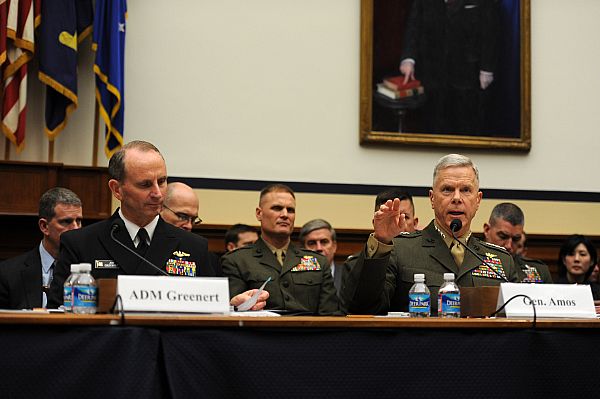
Commandant of the Marine Corps Gen. James F. Amos speaks along side Chief of Naval Operations (CNO) Adm. Jonathan Greenert before the House Armed Services Committee in 2012. US Navy Photo

Joint Chiefs to Congress: Budget Cuts Will Result in Deaths

By:
Commandant of the Marine Corps General James F. Amos speaks along side Chief of Naval Operations (CNO) Admiral Jonathan Greenert before the House Armed Services Committee in 2012. US Navy Photo

Commandant of the Marine Corps Gen. James F. Amos speaks alongside Chief of Naval Operations (CNO) Adm. Jonathan Greenert before the House Armed Services Committee in 2012. US Navy Photo

The Joint Chiefs of Staff made another round of dire warnings about impending sequestration at a hearing Wednesday, this time telling the House Armed Services Committee who may die because of budget problems — and how.
Read More

Under Secretary of the Navy Robert O. Work offers remarks during the fiscal year 2011 Department of the Navy Acquisition Excellence awards ceremony at the Pentagon in June. U.S. Navy Photo

Bob Work on Future Surface Forces

By:

Navy Under Secretary Robert Work torpedoed nostalgia for a 600-ship Navy on Thursday, arguing that today’s Sea Service would far outmatch the peak Fleet size of 1989, and adding that it may be downhill from here.

Work, who spoke at the Surface Navy Association’s 2013 symposium, methodically rebutted claims that the Navy had ever been as large as 600 ships. He pointed out that goals for a much larger Navy than today’s were based on reports that never received official approval or were interim targets as the Fleet drew down.

Under Secretary of the Navy Robert O. Work offers remarks during the fiscal year 2011 Department of the Navy Acquisition Excellence awards ceremony at the Pentagon in June. U.S. Navy Photo

Under Secretary of the Navy Robert O. Work offers remarks during the fiscal year 2011 Department of the Navy Acquisition Excellence awards ceremony at the Pentagon in June. U.S. Navy Photo

While acknowledging that the surface combat fleet has shrunk by about 28 ships, he pointed out that the tradeoff has been for more capable cruisers and destroyers, all of which have guided-missile capability, unlike the ships of old.

Read More

The Coast Guard Cutter Bertholf sails in the Arctic Ocean near Barrow, Alaska, Aug. 28, 2012. U.S. Coast Guard Photo

USCG’s Adm. Papp on Arctic Operations and Caribbean Drug Runners

By:

Even as the Coast Guard gets a grip on the Arctic, drug smugglers in the eastern Pacific are slipping through its fingers, Commandant Adm. Robert Papp acknowledged Thursday.

At the Surface Naval Association Symposium, Papp told reporters he has been forced to give some things up as demands on the Coast Guard increase in the warming Arctic. As he has sent the service’s new National Security Cutters into the frozen north, it has been at the expense of man- and ship-hours for other missions, including drug interdiction in the eastern Pacific.

The Coast Guard Cutter Bertholf sails in the Arctic Ocean near Barrow, Alaska, Aug. 28, 2012. U.S. Coast Guard Photo

The Coast Guard Cutter Bertholf sails in the Arctic Ocean near Barrow, Alaska, Aug. 28, 2012. U.S. Coast Guard Photo

“We don’t have enough ships out there to interdict all the known tracks that we’re aware of,” he said. “We intercept as many as we can.”

Read More

Vice Adm. Tom Copeman, commander of Naval Surface Forces, and commander, Naval Surface Forces, U.S. Pacific Fleet, meets Sailors aboard the Hawaii-based guided-missile cruiser USS Port Royal (CG 73) during a tour of the ship in November. U.S. Navy Photo

Commander Surface Force: Navy is Risking a Hollow Surface Fleet

By:

The head of naval surface forces fears the sea service is teetering dangerously close to an operational cliff where ships simply won’t be available to do what they need to do.Vice Adm. Tom Copeman told the Surface Navy Association Symposium on Tuesday that sailors are being pushed to keep their ships up to snuff without being given enough time, spare parts or training to do proper maintenance. The Navy, he said, has been pushing personnel harder and harder, to do more with less, for years.   Copeman pointed to rampant cross-decking, where sailors are snatched from docked ships and put on board deploying ones, often hindering maintenance on the docked vessel. He also said sailors are likely as not to be unable to find the spare parts they need on board their ship when something malfunctions or breaks. Eventually, he said, a day will come when a ship that needs to deploy won’t be able to.  ”It’s getting harder and harder, I think, for us to look troops in the eye and say, ‘Hey, just do it and meet the standard,’” Copeman said. “Some ships can do it. Some ships can’t.”  Copeman said that the surface navy’s depot maintenance budget is practically at rock bottom right now for the size of the Fleet. If the budget gets any lower, he warned that the Navy risks creating a “hollow” Fleet.

Read More

Flag_of_Lebanon

Syria’s War May Spill Over Into Lebanon

By:

Lebanon is one of the few Middle Eastern countries left that hasn’t been thrown into turmoil by the “Arab Spring.”

But with Syria next door, that may not last long.

Lebanon’s northern urban hub, Tripoli, has long been on the edge of stability. But now that it’s both a destination for Syrian refugees and potentially a rear base for Syrian rebels it has fallen into tit-for-tat killings and urban warfare.

Flag_of_LebanonOn Monday last week, the city was quiet with tension, and cars were backed up as far as the eye could see at military checkpoints.
At the Citadel, a formidable medieval fort that is normally one of Tripoli’s biggest tourist destinations, there was hardly a foreign soul to be seen. Asked why attendance was so light, the government ticket-seller there mumbled, “Syria.”

In the three days following, according to press reports, at least 10 people were killed— most gunned down by snipers on the aptly named Syria Street, which divides a Sunni – Muslim neighborhood from an Alawite one.

Read More

Admiral Greenert: Year One

By:


Cid Standifer is a freelance reporter, web designer and translator based in Arlington, Va. She has written for Military Times, Inside Washington Publishers and the Roswell Daily Record.