Tag Archives: surface

Chief of Naval Operations (CNO) Adm. Jonathan Greenert testifies before the House Appropriations Subcommittee on Military Construction, Veterans Affairs and Related Agencies about the devastating affects of the continuing resolution and sequestration on military readiness. US Navy Photo

Congressional Group Urges Navy to Maintain Ships

By:
Chief of Naval Operations (CNO) Adm. Jonathan Greenert testifies before the House Appropriations Subcommittee on Military Construction, Veterans Affairs and Related Agencies about the devastating affects of the continuing resolution and sequestration on military readiness. US Navy Photo

Chief of Naval Operations (CNO) Adm. Jonathan Greenert testifies before the House Appropriations Subcommittee on Military Construction, Veterans Affairs and Related Agencies about the devastating affects of the continuing resolution and sequestration on military readiness. US Navy Photo

A group of ten Congress members are urging the Navy not to defer maintenance of surface ships as part of the service’s plan to find money to cover mandatory budget cuts. Read More

Under Secretary of the Navy Robert O. Work offers remarks during the fiscal year 2011 Department of the Navy Acquisition Excellence awards ceremony at the Pentagon in June. U.S. Navy Photo

Bob Work on Future Surface Forces

By:

Navy Under Secretary Robert Work torpedoed nostalgia for a 600-ship Navy on Thursday, arguing that today’s Sea Service would far outmatch the peak Fleet size of 1989, and adding that it may be downhill from here.

Work, who spoke at the Surface Navy Association’s 2013 symposium, methodically rebutted claims that the Navy had ever been as large as 600 ships. He pointed out that goals for a much larger Navy than today’s were based on reports that never received official approval or were interim targets as the Fleet drew down.

Under Secretary of the Navy Robert O. Work offers remarks during the fiscal year 2011 Department of the Navy Acquisition Excellence awards ceremony at the Pentagon in June. U.S. Navy Photo

Under Secretary of the Navy Robert O. Work offers remarks during the fiscal year 2011 Department of the Navy Acquisition Excellence awards ceremony at the Pentagon in June. U.S. Navy Photo

While acknowledging that the surface combat fleet has shrunk by about 28 ships, he pointed out that the tradeoff has been for more capable cruisers and destroyers, all of which have guided-missile capability, unlike the ships of old.

Read More

CfleetsF1Oct12

Combat Fleets: China Update

By:

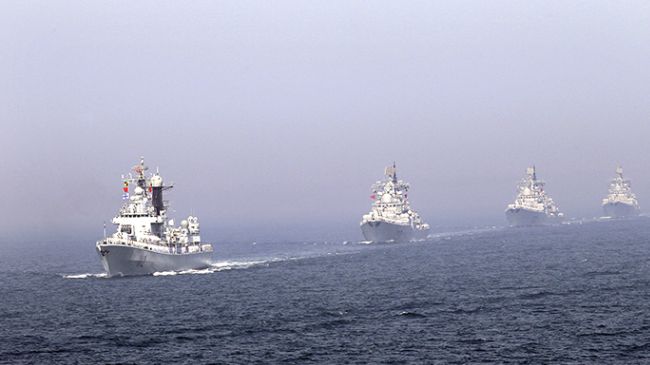
CfleetsF1Oct12The ever-growing reach of China’s navy was demonstrated recently when two of its warships sailed through the Turkish Straits and into the Black Sea for the first time. The two ships, the Luhu-class destroyer Qingdao and Jiangkai II–class frigateYantai (pictured here), entered the Black Sea on 31 July. They then veered off on their own separate visits, with the Qingdaotraveling to Sevastopol, Ukraine, while the Yantai made her own port calls at Costanta, Romania, and Varna, Bulgaria, before the vessels sailed back through the Bosporus and the Dardanelles in early August. Both ships, along with the replenishment oiler Weishanhu , had recently completed anti-piracy patrols

Photo courtesy Cem D. Yaylali
in the Gulf of Aden and off the coast of Somalia. Although the destroyer and frigate entered the Black Sea, the larger 23,000-ton Weishanhu remained docked at Istanbul. Once the ships departed the area, they made a brief stop at Haifa, Israel, before returning home to Chinese waters.

Read More

A British View of the Naval War of 1812

By:

1812constitutionNaval History Magazine, August 2008
The War of 1812 was a conflict between two very different naval powers, a pattern that is far more common in naval history than tends to be appreciated. Aside from a fundamental contrast in their strength—Britain had the world’s leading navy while the United States lacked a battle fleet—the opposing sides used their navies for very different purposes. Because no large-scale naval clashes unfolded on the high seas, it is all too easy to underrate the crucial strategic dimensions of naval power and its importance for the character and development of the war.

more